Project Description
Cambodia's socio-economic landscape underwent significant transformation, shifting from an agriculture-based economy to one focused on industry and services, leading to rapidly increasing trade and transport volumes. To support sustainable and inclusive high economic growth, the Royal Government of Cambodia formulated the Cambodian Industrial Development Policy 2015-2025 (IDP), which highlighted the need for a logistics master plan to create an efficient and competitive platform for trade facilitation.
However, the Ministry of Public Works and Transport (MPWT) faced challenges including a lack of skilled human resources for logistics management, insufficient database systems, a lack of monitoring and evaluation mechanisms, and limited financial and technical support for formulating a logistics database system.
Our Core Objectives
1
To enhance the capacity of government officials in developing logistics M&E frameworks and databases for effective tracking of logistics activities in the Mekong region, with a focus on Cambodia, Lao PDR, and Viet Nam (CLV countries).
2
To develop a standardized logistics M&E guide to support logistics development in the Mekong region.
3
To establish a central logistics database system for the Mekong region to ensure sustainable logistics development and support policymaking through reliable data.
Activities / Components
1
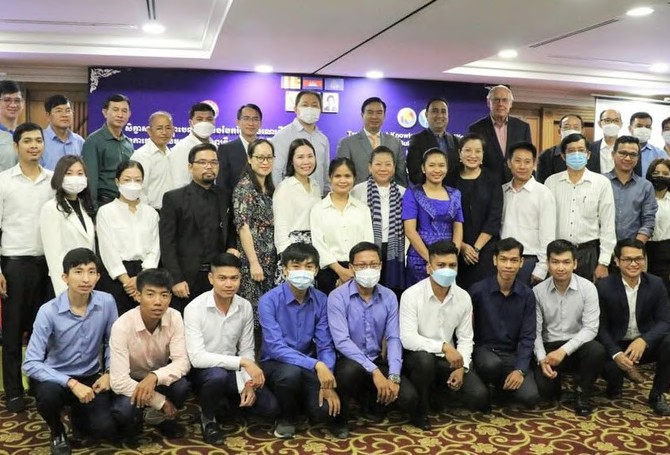
To enhance the data collection, management, and evaluation capabilities of both the public and private sectors in logistics, and to strengthen regional integration and cooperation, the professional capabilities of government officials and relevant personnel will be gradually improved through training and technical support.
2
A multilateral cooperation platform will be established, and the process will progress in phases and in a planned manner—from the national to the regional level, and from framework development to database construction.
Results Achieved
-
The development of the Logistics Statistics Management and Monitoring & Evaluation (M&E) training module was completed, and multiple domestic and international training and technical exchange activities were successfully organized, significantly enhancing the data analysis and management capabilities of relevant government officials and private sector personnel.
-
The M&E framework for logistics in Cambodia was initially formulated, and the framework for the CLV region entered the stage of soliciting opinions and revision, laying the foundation for a unified regional policy. The design and beta version of the CLV logistics database system and the Cambodian geographic database were developed, with data import and platform optimization currently in progress.
-
Two key case studies—the "Baseline Study on Logistics Development in Cambodia" and the "Follow-up Monitoring and Evaluation Report"— completed their initial drafts and were reviewed at a technical meeting, providing an important basis for policy making. The project also promoted the establishment of a data-sharing mechanism among the three CLV countries and was drafting the MoU text to formalize the regional data collaboration framework.
Successful Factors/Strategies
- Clear problem orientation and demand matching were central to the project design, precisely focusing on the bottlenecks faced by Cambodia and the CLV countries in logistics development—such as data scarcity, insufficient capacity, and mechanism deficiencies—ensuring the project's urgency and policy relevance.
- By establishing a monitoring and evaluation framework and a database system, an institutional basis was provided for long-term sustainable management.
- Emphasizing regional cooperation and experience sharing through technical exchanges, visits to third countries, and working groups involving the three CLV countries strengthened coordination and mutual trust, enhancing the regional applicability and replicability of project achievements.
Future Strategies and Plans
- The project outcomes will be incorporated into the long-term working mechanism of the General Directorate of Logistics (GDL), a permanent institution under the Ministry of Public Works and Transport (MPWT) of Cambodia, to ensure the continuous update and utilization of the database and M&E system.
- The project plans to regularly support data collection and system maintenance through the national fiscal budget and transform training efforts into a "trainer" model to form a localized talent pool. Regionally, efforts will be made to promote the signing of a Memorandum of Understanding (MoU) on long-term data sharing and cooperation among the three CLV countries and to strengthen the cross- border coordination mechanism.
- Regularly releasing logistics and transportation briefs and continuously disclosing logistics development data and trends to the public will enhance policy transparency and public participation.